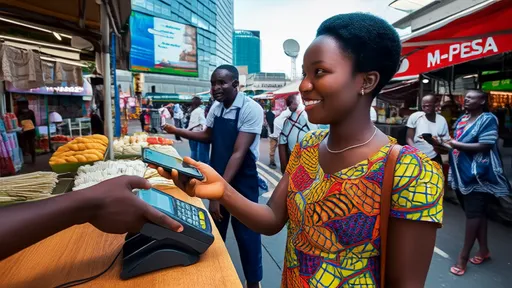
In the bustling markets of Nairobi, a quiet revolution has been unfolding for over a decade. Street vendors, taxi drivers, and small business owners conduct transactions not with crumpled banknotes, but with the tap of a mobile phone. Kenya has firmly established itself as Africa's undisputed leader in mobile money, with monthly transaction volumes consistently surpassing the $5 billion mark, creating an economic ecosystem that has become the envy of developing nations worldwide.
The story of Kenya's mobile money dominance begins with M-Pesa, a service launched by Safaricom in 2007 that would fundamentally reshape the country's financial landscape. What started as a simple system for microfinance loan repayments has evolved into a comprehensive financial platform used by over 80% of Kenya's adult population. The service's staggering growth reflects a deep understanding of local needs and a willingness to innovate beyond traditional banking paradigms.
Kenya's mobile money ecosystem now processes transactions equivalent to nearly half of the country's GDP annually, demonstrating how deeply embedded these services have become in everyday economic life. From urban professionals paying utility bills to rural farmers receiving payments for their produce, mobile money has bridged gaps that traditional banking infrastructure could never reach. The system's resilience was particularly evident during the COVID-19 pandemic, when transaction volumes surged as people sought contactless payment methods.
Several factors have contributed to Kenya's remarkable position in the mobile money landscape. The country's high mobile penetration rate, standing at over 100% due to multiple SIM card ownership, provided the necessary infrastructure for widespread adoption. Additionally, a regulatory environment that initially allowed for innovation while gradually implementing safeguards created space for mobile money to flourish without being stifled by premature restrictions.
The Central Bank of Kenya's forward-thinking approach has been instrumental in this growth. Rather than imposing stringent banking regulations on mobile money operators from the outset, regulators adopted a watchful stance that allowed for organic development while maintaining financial stability. This balanced approach has since been studied by central banks across Africa and beyond as a model for fostering fintech innovation.
Beyond the sheer volume of transactions, what makes Kenya's mobile money story compelling is how the ecosystem has evolved. What began as simple peer-to-peer transfers has expanded to include savings products, international remittances, merchant payments, and even credit scoring. Services like M-Shwari, which offers savings and loan products through mobile platforms, have brought formal financial services to millions who previously existed outside the banking system.
The impact on financial inclusion cannot be overstated. Before the advent of mobile money, only about a quarter of Kenyans had access to formal banking services. Today, that figure has more than doubled, with mobile money accounts serving as the primary financial tool for the majority of the population. This transformation has had profound effects on poverty reduction, women's economic empowerment, and small business growth.
Small and medium enterprises have particularly benefited from the mobile money revolution. The ability to receive payments digitally has reduced the risks associated with handling cash, while access to digital credit has provided working capital that was previously inaccessible. For farmers in remote areas, mobile payments have eliminated the need to transport large sums of money over long distances, significantly improving security.
Kenya's success has not gone unnoticed internationally. Development agencies, governments, and telecommunications companies from across Africa and other developing regions have studied the Kenyan model, seeking to replicate its success. However, many have discovered that simply copying the technology without understanding the unique social, economic, and regulatory conditions that enabled Kenya's growth often leads to disappointing results.
The competitive landscape in Kenya continues to evolve, with new players entering the market and existing services expanding their offerings. Airtel Money, though significantly smaller than M-Pesa, has gained traction by offering lower transaction fees and innovative products. Meanwhile, traditional banks have been forced to adapt, either by partnering with mobile money providers or developing their own digital offerings to remain relevant.
Looking ahead, Kenya faces both opportunities and challenges in maintaining its leadership position. The integration of mobile money with other emerging technologies, including artificial intelligence and blockchain, promises to further enhance services and reduce costs. However, concerns about cybersecurity, consumer protection, and market dominance by a single player require ongoing attention from regulators and industry participants.
The international dimension of Kenya's mobile money success is becoming increasingly important. As Kenyans living abroad seek to send money home more efficiently, and as Kenyan businesses expand across borders, the demand for cross-border mobile money services continues to grow. Partnerships between Kenyan mobile money providers and international payment processors are making it easier and cheaper to move money across continents.
Perhaps the most significant testament to Kenya's mobile money revolution is how it has changed the country's cultural and social fabric. The phrase "send me M-Pesa" has become part of everyday language, and the service has become so integrated into daily life that many young Kenyans cannot imagine a world without instant digital payments. This cultural adoption, combined with continuous technological innovation, suggests that Kenya's leadership in mobile money is likely to continue for the foreseeable future.
As other African nations work to develop their own digital finance ecosystems, Kenya serves as both an inspiration and a cautionary tale. The country's success demonstrates the transformative potential of mobile money, but also highlights the importance of tailoring solutions to local conditions rather than attempting to import models wholesale. The continued evolution of Kenya's mobile money landscape will undoubtedly provide valuable lessons for the global fintech community.
The story of mobile money in Kenya is far from complete. With new technologies emerging and consumer expectations evolving, the sector continues to innovate at a rapid pace. What remains clear is that Kenya has not only created a successful mobile money industry but has fundamentally reimagined what inclusive financial systems can look like in the digital age. The monthly transaction volumes exceeding $5 billion represent not just economic activity, but the daily financial lives of millions of Kenyans who have embraced a new way of managing money.

By /Nov 5, 2025

By /Nov 5, 2025
By /Nov 5, 2025

By /Nov 5, 2025

By /Nov 5, 2025
By /Nov 5, 2025

By /Nov 5, 2025

By /Nov 5, 2025
By /Nov 5, 2025
By /Nov 5, 2025

By /Nov 5, 2025

By /Nov 5, 2025
By /Nov 5, 2025
By /Nov 5, 2025

By /Nov 5, 2025

By /Nov 5, 2025

By /Nov 5, 2025
By /Nov 5, 2025

By /Nov 5, 2025